

Meet the Finalists
We proudly present our 62 Finalists for the 2026 ACAR Art Prize.
Winner to be announced 17th April 2026
Aixiao Li
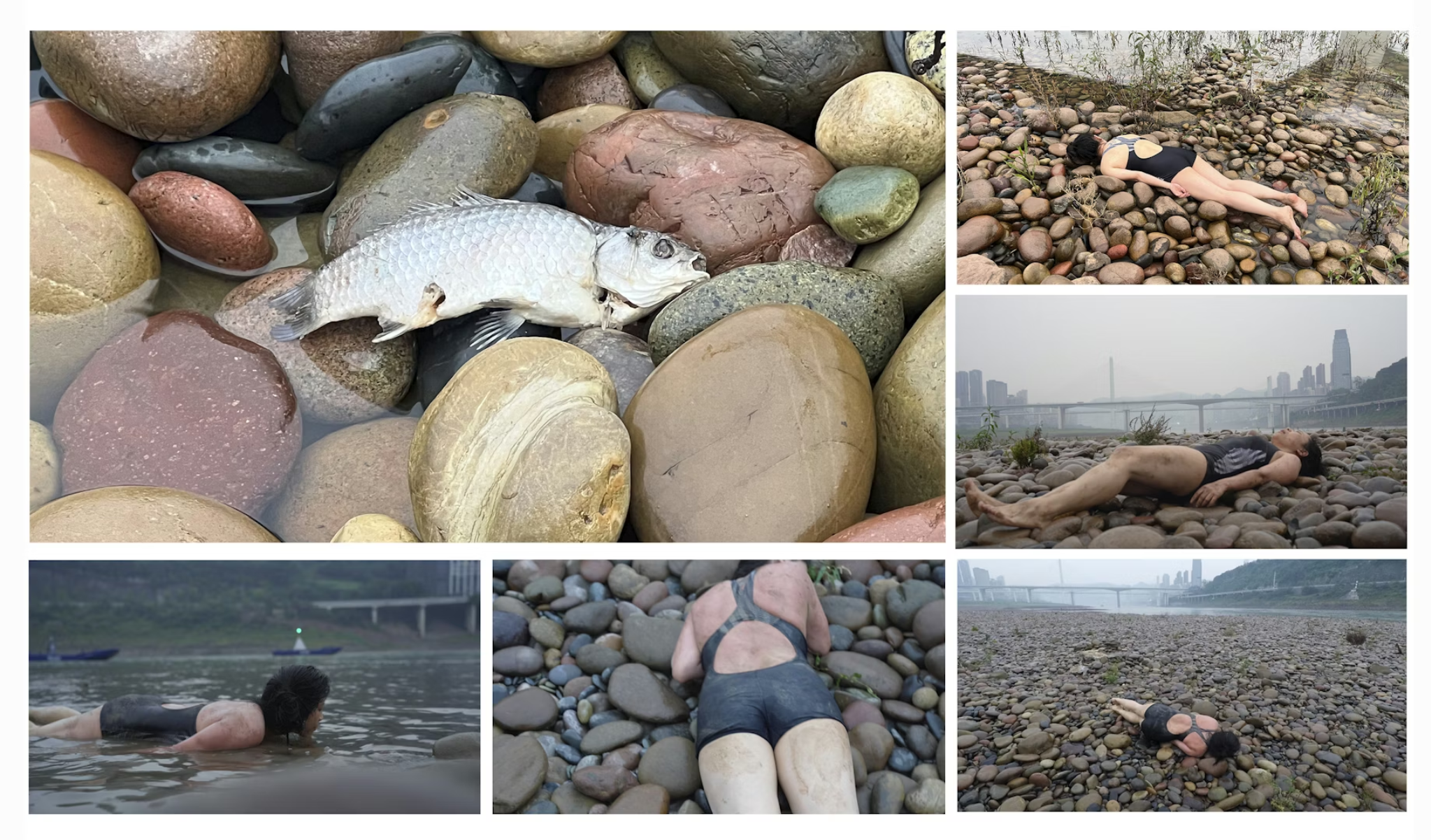
Title: Fish of the Yangtze River
At the centre of the Yangtze River riverbed, beside a stagnant pool formed by drought, Li moves like a fish, exerting her full strength to roll and struggle back toward the flowing river. The action takes 53 minutes and spans over one kilometre. Through this gesture, she draws close attention to the ecological crisis of the Yangtze’s drying, while also reflecting on her own present condition.
The Yangtze becomes a site where body, time, and action intersect. Through the metaphor of “human–fish,” she binds individual life to the natural ecosystem, forming a shifting landscape. The dried riverbed and the struggling body together constitute a narrative of “reconstructed landscape.”
Angela Malone
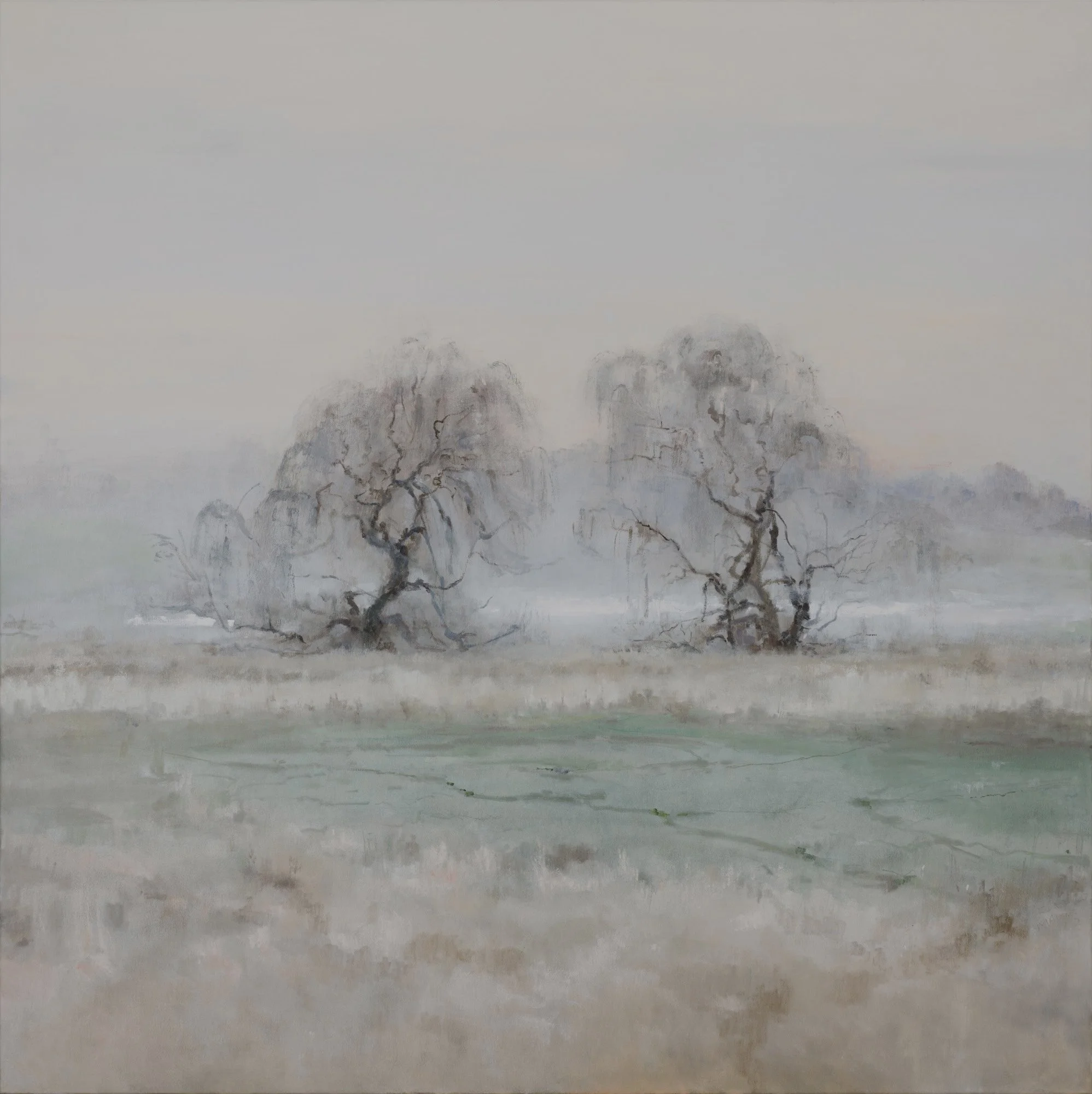
Title: Two Willows in June
Duckweed Lake, ( Wang Wei ( 701-761))
Beside this spring lake deep and wide, I find myself waiting for your light boat to return: duck weed slowly drifted together behind you, and now hanging willows sweep it open again.
Over many decades my encounters with Chinese poetry and painting have influenced the way I have experienced this deeply familiar landscape I have known since birth and the way I have painted it. The artists and poets speak to me across time; their yearnings are my yearnings, and so too, their sorrows are my sorrows. Although it is possible to locate the very “two trees in June” depicted in this painting, it is the inner experience of landscape that I want to share with others, what it may feel like, even for the smallest moment, to manifest the mind as landscape; to feel inseparable from the trees, the grasses, the mists, the wind.
Angus Nivison
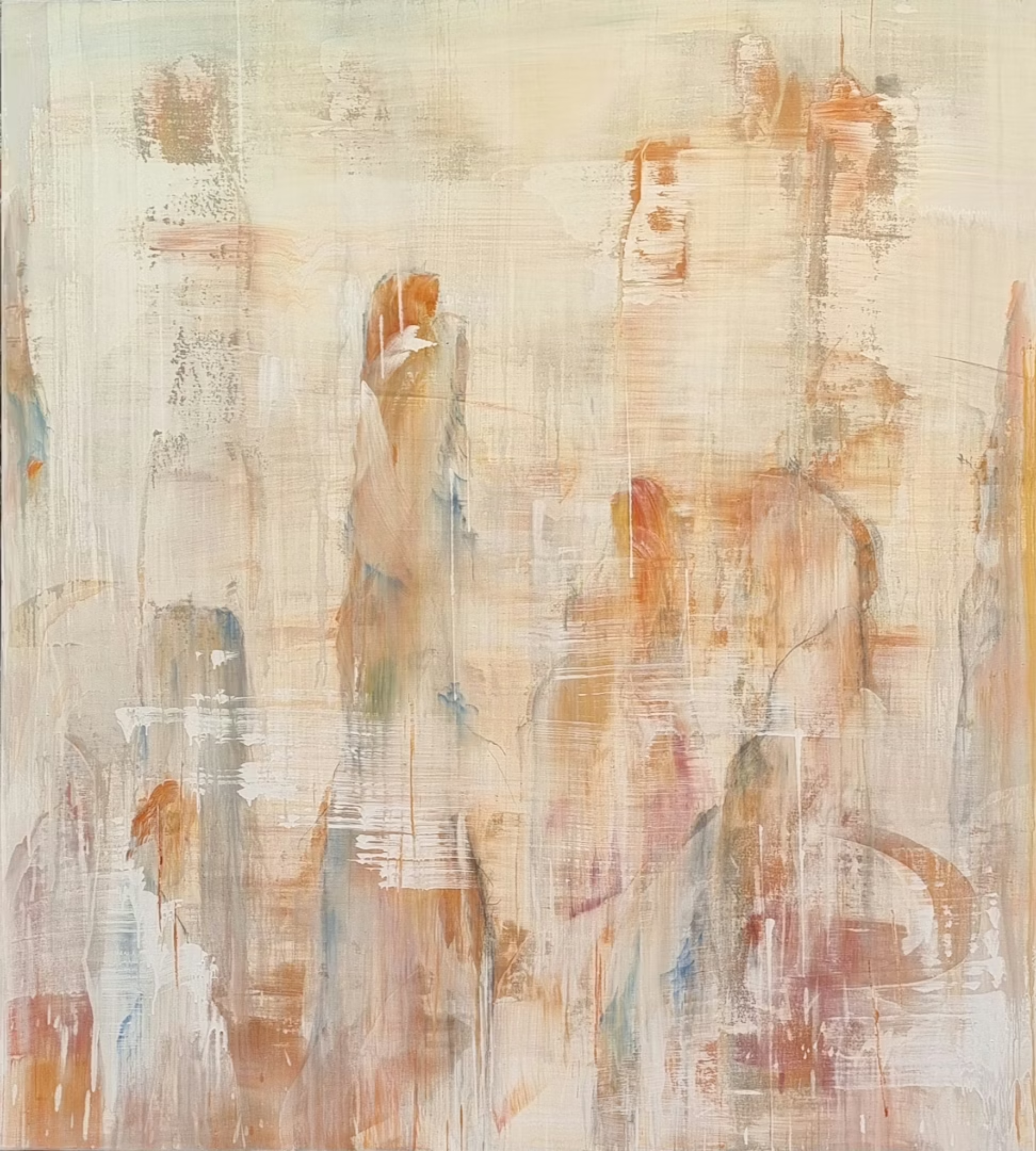
Title: Veiled Landscape Zhangjiajie #1 Revisited 2017-2025
Throughout my long career as a painter, viewers of my paintings have commented “have you ever been to China, you have a Chinese sensibility!” and I would reply wistfully,” no but I would love to visit one day.” Many years later in 2017 the chance arrived and I visited Zhangjiajie China with the Nock Art Foundation, and in December2018 exhibited at the Nockart Gallery in Hong Kong. Veiled Landscape Zhangjiajie #1 has been in storage ever since with the intention of a rework.
When the ACR prize came up the opportunity presented to do just that. ‘Veiled Landscape Zhangjiajie #1 Revisited 2017-2025’ is the end result. The work, being repainted after an eight year absence, departs from the literal view, with many perspectives and glimpses if you like, of misty obscured vistas, both physical and imagined. What we have now is a memory and a longing of Zhangjiajie China.
Baohua Li
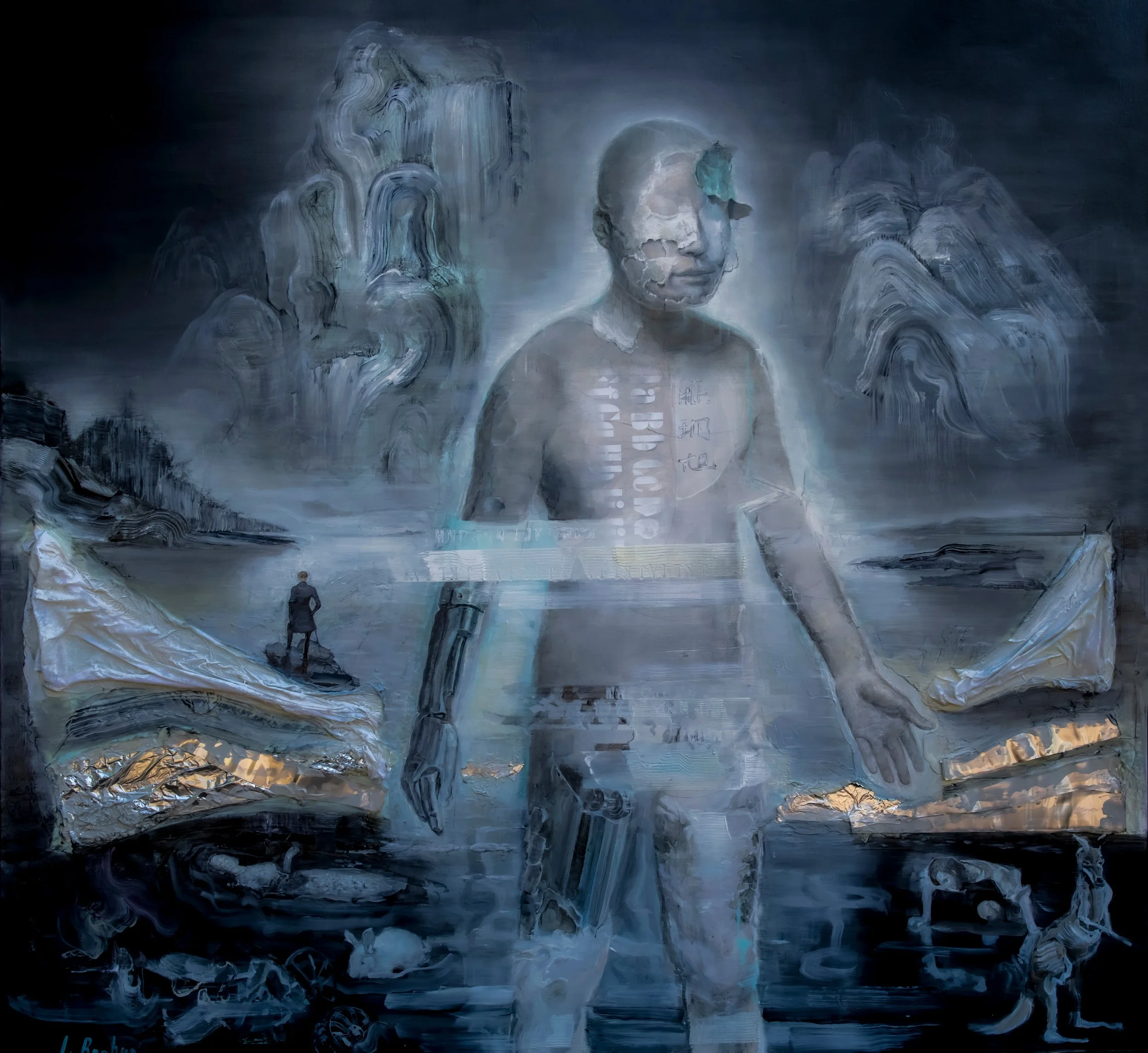
Title: A Person's Journey, 2025
"Landscape Reimagined" carries a dual significance: one refers to the transformation of external physical space, the other to the reconstruction of one's implicit inner world—of spiritual perception and meaning.
As an artist of Chinese background, setting foot in Australia thirty-five years ago, I came to recognise the distinct ways of life, thought, and perception held by other cultures across. Three decades ago, I painted a self-portrait. This time, I take myself as the starting point once again, entering into a dialogue with that earlier self-portrait.
Human beings are part of the landscape as well. I allow the roles of people and landscape to interchange—subject becomes object, object becomes subject. Past, present, and future are juxtaposed within the same painting. This exploration touches upon the transformation of identity and the relationship between humanity and the natural universe.
All answers lie hidden within the painting, waiting to be interpreted by the viewer.
Belinda Fox
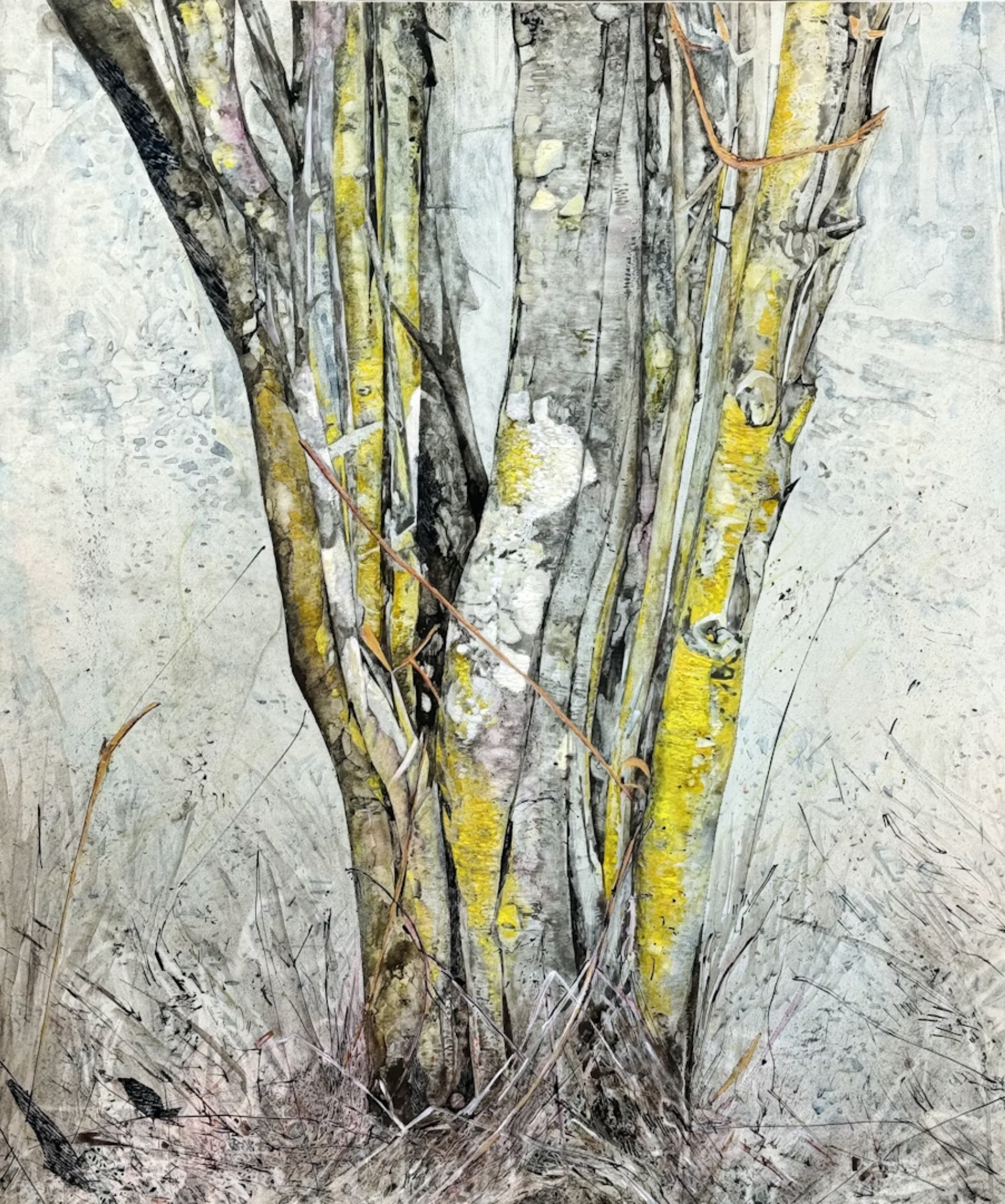
The Light Catcher reflects my ongoing attempt to understand the distinct subtleties of the Australian bush. After years travelling through Beijing, Tibet, Hong Kong, Shanghai and living in Singapore, I absorbed a wide spectrum of Chinese cultural expression and artistic tradition. Those experiences shaped how I look and how I paint. My materials—Chinese ink, brushes, sticks, incidental marks—are a direct homage to the Chinese works on paper I deeply admire. Their clarity, restraint, and the principle of liubai (purposeful emptiness) inform the sparse, singular focus of this composition.
In my surrounds, the landscape is muted and slow to reveal itself. I’m still learning it. Yet during one dusty bush walk, a single lichen-coated Bursaria spinosa glowed like a small beacon—an almost surreal flash of yellow. Painting it became a way to bridge my Asian visual sensibilities with this Australian terrain, finding connection through attention and quiet illumination.
Title: The Light Catcher
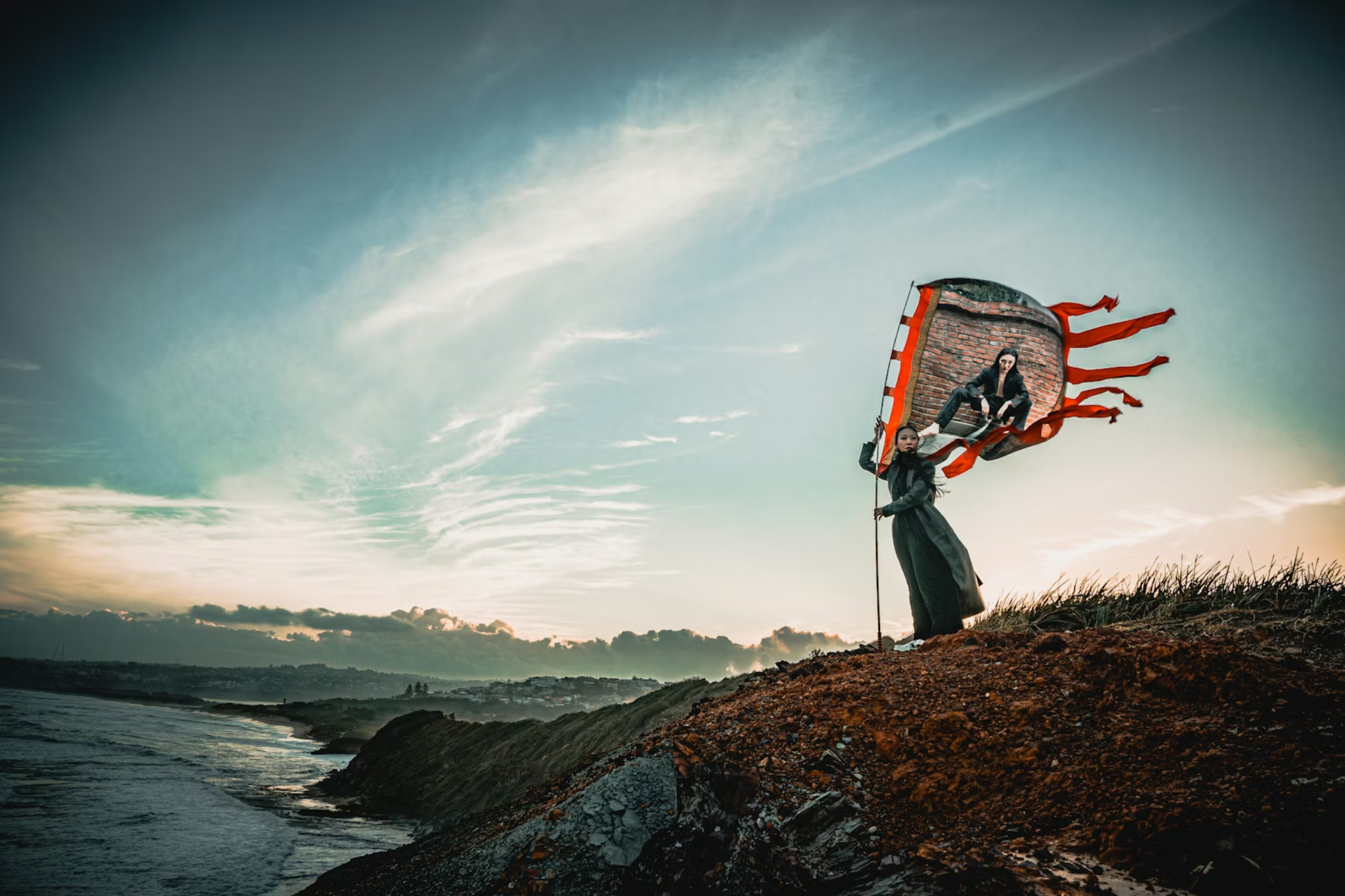
Cao Yu
Title: Dragon Head · Shanhe Declaration, 2021-future
This is Cao Yu’s transnational project which has been ongoing for 5 years across 8 countries spanning Eurasia, Australia. Including performance, sculpture, documentary, photography. Rejecting art as an elite financial product, she spreads it like dandelion seeds into daily life. Using her body as a base, she shoulders an ancient trident battle flag across inhabited and uninhabited lands.
Water from the broken tap bursts with primitive vitality, jumping out of the sink’s boundaries, escaping the fate of flowing into the path designed by others. People demand the broken tap fixed, just as they label world-changers “broken” lunatics. Unless fixed, the water flows endlessly, forming future’s unpredictable torrent.
The artist becomes an androgynous, Mulan-like figure, seeming to declare anyone can cast aside innate boundaries, create fearlessly without gender distinction. Anywhere can be an art battlefield. Like a commander without an army, courage and creativity are troops. This work is her powerful declaration to the whole world.
Charlie Sheard
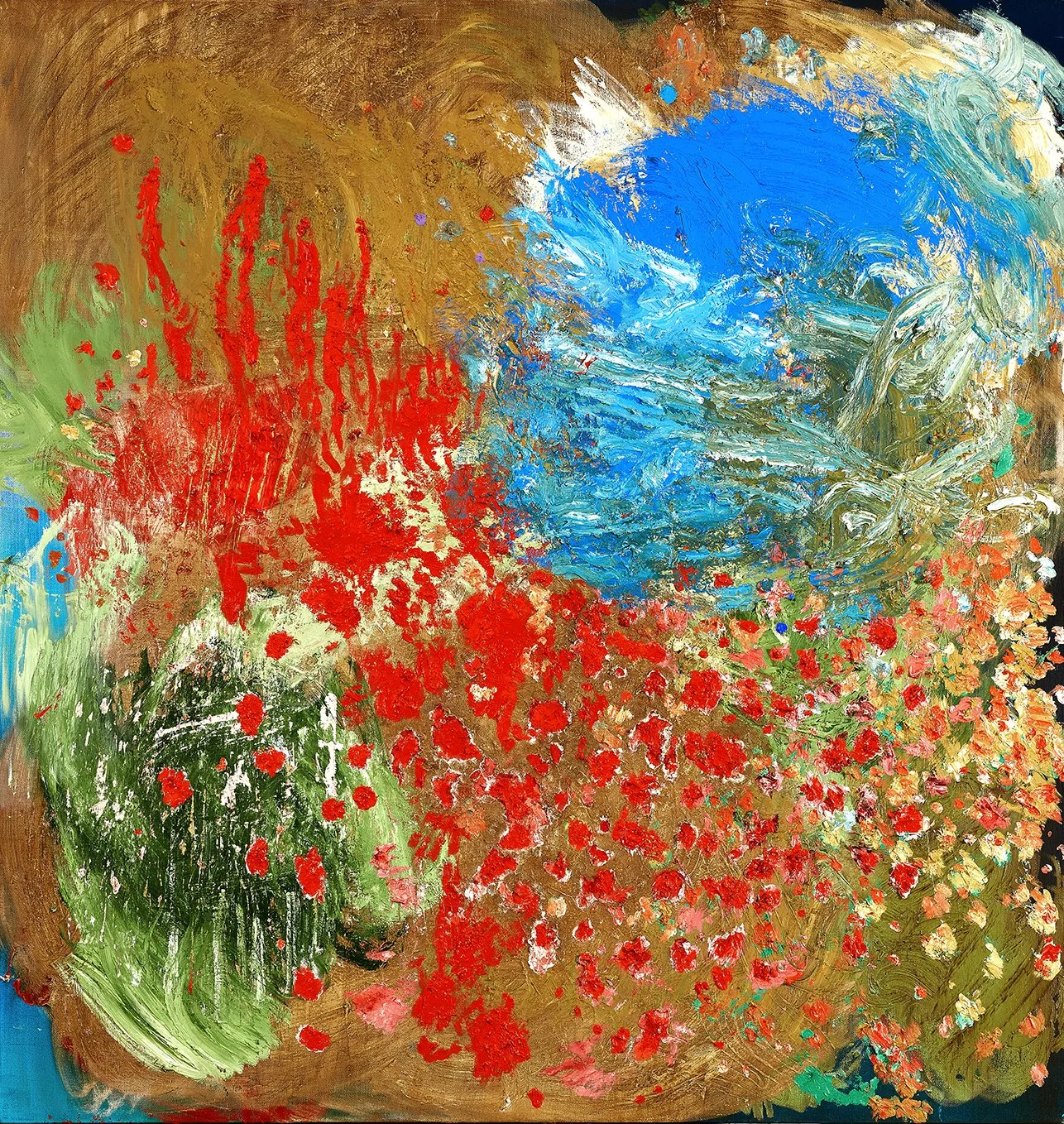
Title: χάος μανία δακρύων, 2025
The history and style of painting, both in China and in Australia, are formed around landscape. χάος μανία δακρύων is embedded in this history, in the history of European oil painting, and in Song Dynasty landscape painting. The flow of energy (qi) is everything here.
“At the deepest level, painting in the Chinese tradition is not merely an act of representation, but a pursuit of Dao — the unbroken totality of existence. Within this cosmology, painting becomes a way of participating in the rhythm of creation itself. The artist does not invent forms but joins the unfolding of Dao, tracing the moment when formlessness becomes form, when void condenses into presence.” – Xiao Huang
Sydney artist Charlie Sheard has held four solo exhibitions and numerous group exhibitions in China. He has lectured at CAFA Beijing and collaborated with Chinese artists. His work is featured in the recent Art Market review for 2024.
Christopher Hodges
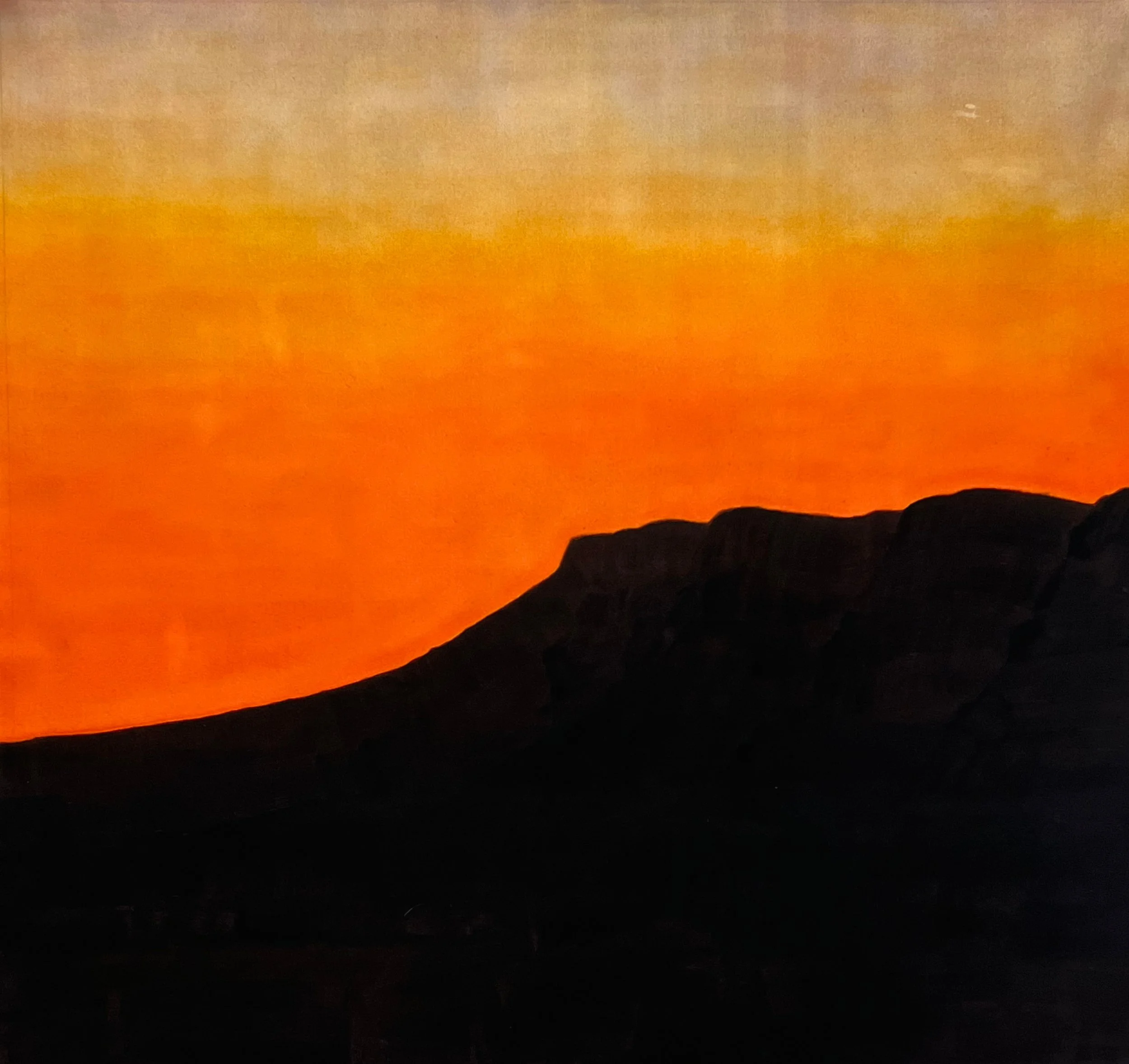
Title: Cockburn Range Sunset
When I was 10 years old, I got my first job as the delivery boy for Mr Sun’s Grocery Shop just down the road. Mr Sun and his son Gilbert were instrumental in this early part of my life, and their contribution still means a lot to me.
I have travelled to China, and the landscape made an impression on me. I travelled down the Yangtze River and in the countryside around Xian. And a walk along the Great Wall was a revelation. I am lucky to have some of my work in a collection in China and it is the great capacity of art to reach out across cultural boundaries that has fostered such a good relationship with a Chinese collector. There is something universal in the way all people stand in awe of nature and this picture captures a moment that could occur almost anywhere in the world
Dapeng Liu
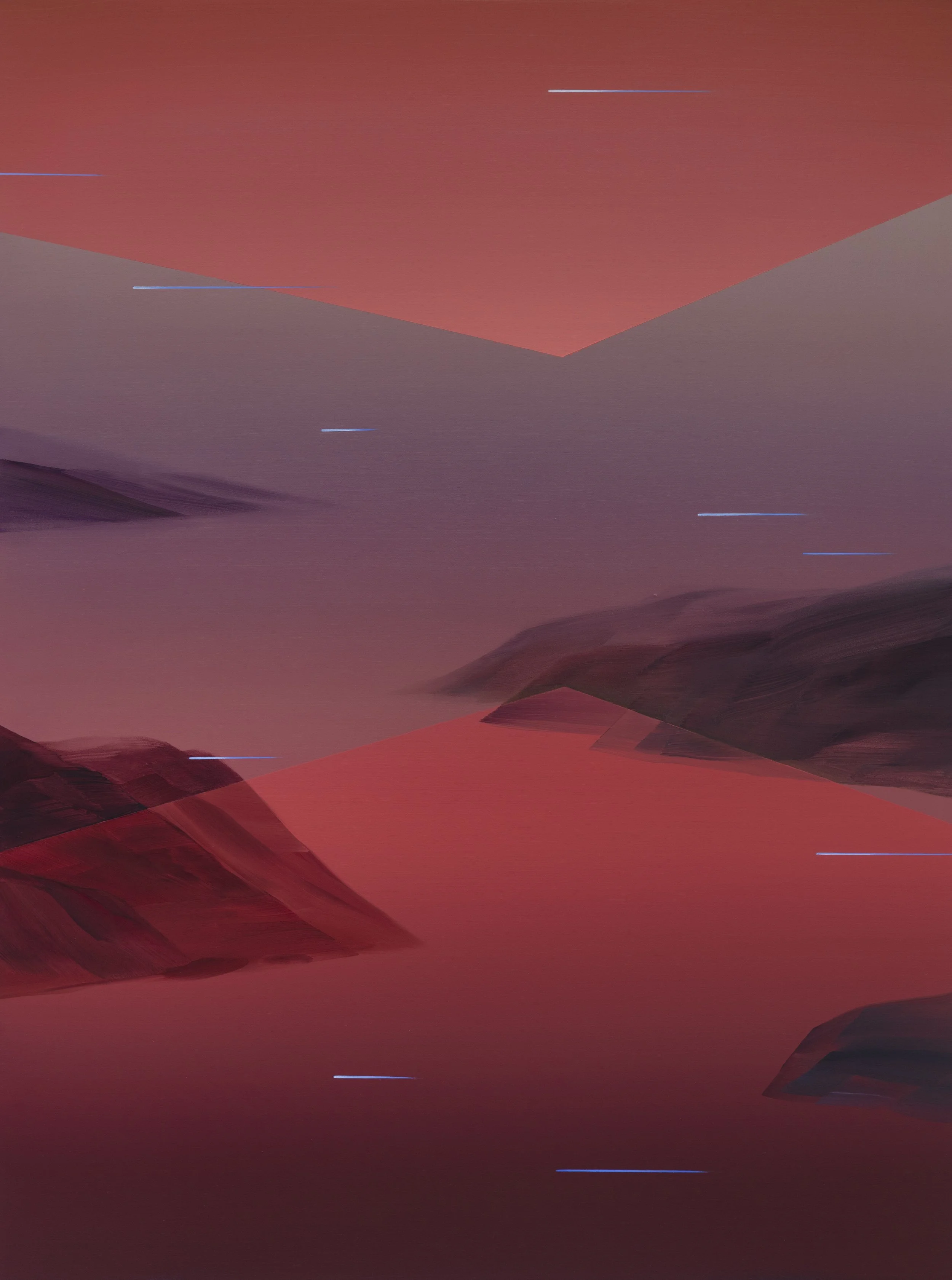
Title: We Move Through Borrowed Light
We Move Through Borrowed Light reimagines landscape as a meeting point between human systems of understanding and the inherent order of nature. Drawing on the spatial sensibilities of Chinese landscape painting, the work translates these ideas into a contemporary visual language.
Mountains and terrains appear as shifting presences, partially veiled by translucent geometric planes. These forms reference architecture and measurement—structures through which humans interpret and organise the world, while their translucency blurs distinctions between abstraction and figuration, and between the natural and the constructed.
The painting presents landscape as layered and contingent, shaped by perception, memory, and cultural inheritance.
David Collins
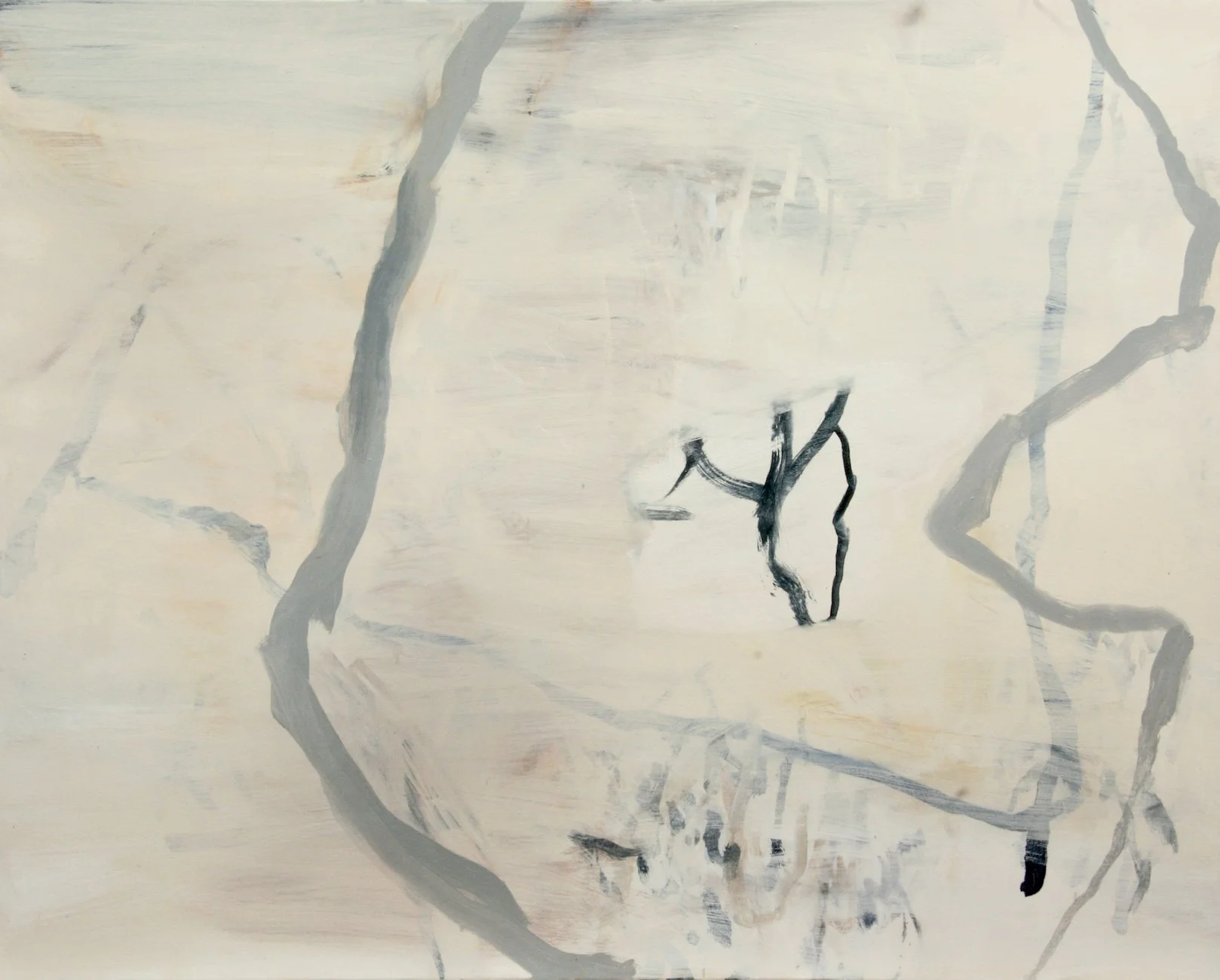
Title: Mangrove Window
I have long held a fascination for Chinese landscape painting and calligraphy, particularly the unique understanding of space and the expressive use of line in both traditional and contemporary work.
This interest was further developed when, in 2004, I was offered a teaching position and artist residency in the Department of Fine Art at The North West University for Minorities, Lan Zhou, China.
Being absorbed in the diverse cultures of Central China, meeting regularly with painters and calligraphers and looking deeply at their work had a profound influence on my own practice as an Australian landscape painter.
I paint with large calligraphy brushes and draw on the environment in which I live, The Hawkesbury River, in NSW, particularly the mangrove forests that line its shores. Their spaces, water surfaces and expressive lines are an endless fascination and my interpretation draws directly from my ongoing engagement with Chinese painting and calligraphy.